You already own a straightening iron, and every styling video you watch shows soft, bouncy curls made with a tool that looks exactly like yours. Here is the direct answer: yes, a straightening iron can curl hair, and for most hair types it does the job just as well as a dedicated curling iron. Round barrel edges, plate material, and heat control decide how well it curls — not the label on the handle. This guide explains what to check before you buy, how to create curls in six steps, which temperature your hair type can safely handle, and the mistakes that quietly ruin your results.
Using one tool for two looks is the practical reason to master this technique: a quality straightener replaces a second appliance, saves drawer space, and cuts the cost of building a styling kit. The method below is the same one salon stylists use when they curl hair with a flat iron.
What Plate Type Gives the Best Curl?
Curls form when the plates glide smoothly and heat evenly. If the tool grips, drags, or cools at the edges, you end up with a kinked or half-curled strand. Three plate types dominate the market, and each behaves differently in the twisting motion that creates flat-iron curls.
| Plate |
Best For |
Curl Behaviour |
Heat Notes |
| Ceramic |
Fine to normal hair |
Even, gentle glide; softer waves |
Gradual heat-up, steady temperature |
| Titanium |
Thick, coarse, or naturally curly hair |
Slick glide; defined, tighter curls |
Fast heat-up, higher maximum temperature |
| Tourmaline coated |
Frizzy or dry hair |
Shiny curls with less static |
Releases negative ions to seal the cuticle |
Plate material affects how smoothly the iron twists around the strand, which directly controls curl definition.
For curling specifically, rounded barrel edges matter more than plate width. A 1-inch plate with beveled edges produces the most consistent ringlets; a 1.5-inch plate makes loose, voluminous waves. If you want one tool for both straight and curly styles, 1 inch is the practical middle ground.
How to Curl Hair with a Straightening Iron
The principle is simple: clamp, twist, glide, release. The details decide whether the curl survives until evening. Work on completely dry hair — moisture trapped between the plates turns to steam, flattens the curl, and roughs up the cuticle.
- Spray a heat protectant over dry hair and comb through so no strand is tangled.
- Divide the hair into 1-inch sections and pin the rest out of the way.
- Clamp the iron near the root, roughly half an inch from the scalp, with the plates closed gently.
- Twist the iron 180 degrees away from your face to wrap the strand around the barrel.
- Glide slowly down the strand — about 3 to 5 seconds per inch — and release at the ends.
- Let the curl cool in your palm for 10 seconds before touching it, then repeat on the next section.
For face-framing waves, alternate the twist direction section by section. Start at the nape and work forward for an even head of curls. If you are new to tool-based curling, the guide on how to use hair curlers covers the same principles from the curler side.
Set the Temperature by Hair Type
The safe styling window is 300°F to 410°F. Below 300°F curls fall out; above 410°F damage begins.
Heat below 300°F (150°C) is too weak to reshape the hydrogen bonds that hold a curl, so the wave drops within an hour. Above 410°F (210°C), the hair cortex starts to break down, which leads to split ends and a dull finish. Find the lowest setting that actually holds your curl:
- Fine or bleached hair: 300–330°F (150–165°C)
- Normal or color-treated hair: 330–360°F (165–180°C)
- Thick or coarse hair: 360–400°F (180–205°C)
Adjustable temperature control is non-negotiable for curling. Many ODM-built salon brands now include digital temperature displays so you can lock in the exact degree instead of estimating. If you want to skip the blow-dry step, a wet-to-dry rated model applies a higher heat zone with moisture vents to work on towel-dried hair.
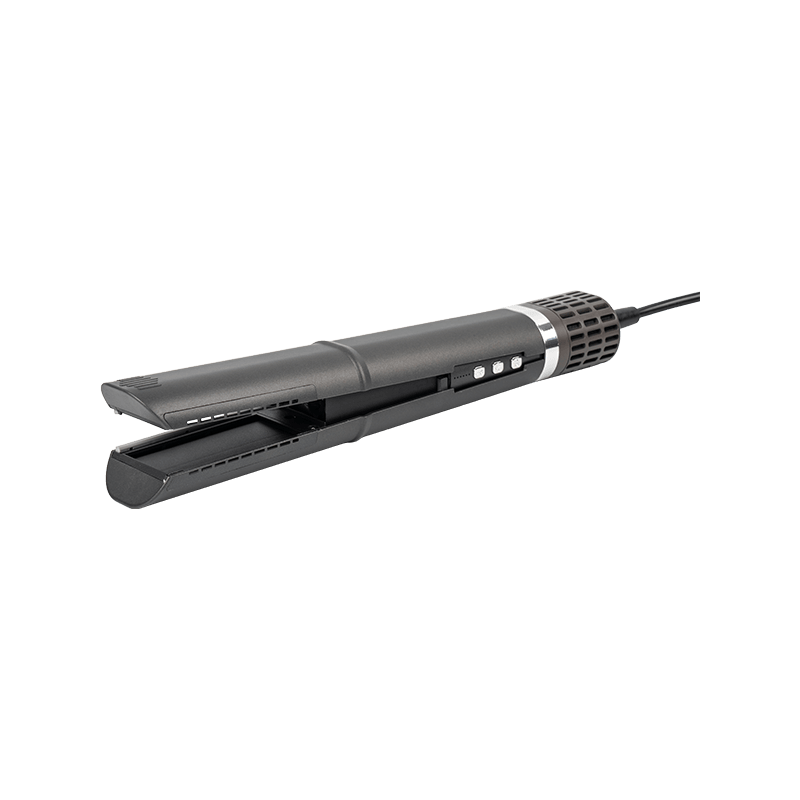 JYS-C6 Professional 2-in-1 Wet & Dry High-Speed Straightener with BLDC MotorThis wet-to-dry rated straightener with a 110,000 RPM brushless motor and 9 temperature settings suits those who want to skip pre-drying. Its elastic strips and self-cleaning function add practical value for daily styling.View Product →
Wet-to-dry styling shortens the routine considerably: you move from towel-dried hair to finished curls without a dedicated drying pass. Just confirm the device is certified safe for wet use — using a regular straightener on damp hair is one of the fastest ways to cause thermal damage.
Five Mistakes That Undo Flat-Iron Curls
Most flat-iron curl failures are technique errors, not tool faults. Fix these five issues and the same iron behaves like a different product.
| The Mistake |
The Fix |
| Gliding too fast, under 2 seconds per section |
Slow down to 3–5 seconds so the heat penetrates the strand and sets the bend. |
| Taking sections wider than 1 inch |
Oversized sections heat unevenly. Keep each section small enough to sit fully between the plates. |
| Touching the curl while it is still warm |
Let every curl cool to room temperature before brushing, tousling, or pinning it. |
| Clamping with too much pressure |
Firm contact is enough. Heavy pressure leaves a crease at the clamp line and stresses the cuticle. |
| Curling hair that is still damp |
Use a wet-rated tool or blow-dry fully. Escaping steam flattens the curl and risks heat damage. |
Correcting these five technique errors changes the result more than upgrading the tool.
Tips for Curls That Last Until Evening
Once your technique is clean, a few professional adjustments take the style from “just left the mirror” to “still curly at dinner.”
Cool completely before breaking the curl. The curl is a heat-set shape; touching it early relaxes the hydrogen bonds. Ten seconds of patience separates an all-day wave from a flat strand.
Alternate twist directions. Away from the face on one side, toward the face on the other — this copies the natural fall of the hair and avoids the uniform “corkscrew curtain” look.
Dust dry shampoo at the roots before curling. It adds the grip a flat iron needs to wrap the strand and absorbs the oils that pull waves straight by midday.
Refresh drooping curls at a lower temperature. Re-pass a fallen curl at 280–300°F instead of your full styling temperature; less heat, same result.
For dry or fragile hair, a hydrating straightener reduces the air-frying effect of repeated passes. Steam-mist models inject moisture into the strand while the plates close, a practical feature for anyone curling daily.
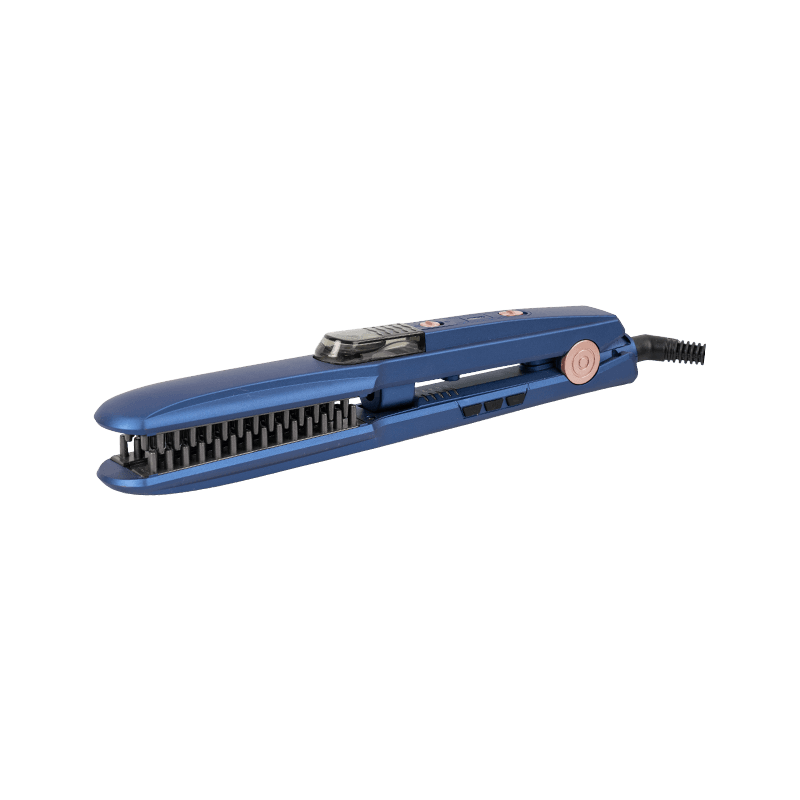 JYS-C3 Ultrasonic Steam Mist Hydrating Straightener with 5 TemperaturesIdeal for dry or fragile hair, this model injects moisture via ultrasonic steam while straightening. With dual voltage and a removable water tank, it offers practical travel convenience and even heat across five temperature settings.View Product →
What to Check Before You Buy
If you are shopping for your first curling-capable straightener, these five checkpoints filter out the tools that simply cannot hold a curl. They apply whether you are choosing a retail brand or evaluating an OEM-supplied private label.
Rounded plate edges. Sharp edges bite into the strand during the twist and leave a visible crease. Look for a beveled or chamfered barrel.
Adjustable temperature with a display. Fixed-temperature irons usually sit at 400°F — too hot for fine hair, too weak for thick hair.
1-inch plate width. The sweet spot for alternating between straight and curly styles. Narrower plates make tighter ringlets; wider plates make wavier shapes.
Fast heat-up and auto shut-off. A 30-second heat-up keeps the morning routine moving, and auto shut-off removes the risk of leaving a hot iron on the counter.
Swivel cord and dual voltage. Cord kinks pull the iron out of alignment mid-glide. Dual voltage lets you keep the same settings while travelling.
Compact versions of the 2-in-1 wet/dry straightener cover most of these points in a smaller body, making them a reasonable pick for home use and overnight trips.
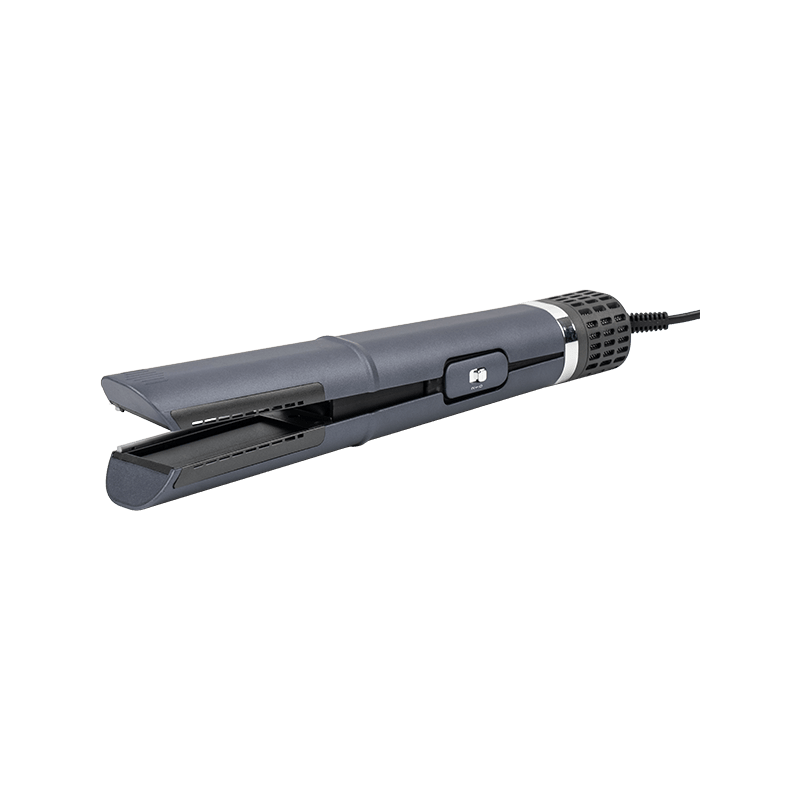 JYS-C6-B Compact 2-in-1 Wet & Dry Straightener with Dual Temperature ControlA smaller wet-to-dry straightener with gentle elastic strips and a reliable DC motor, offering simple two-temperature control. It suits home use and trips while reducing styling time on damp hair without excessive heat.View Product →
Whichever you choose, run a low-heat test on one section before trusting your whole head to a new model. Clamp, twist, glide, and see how the curl holds for the next hour — no spec sheet predicts how a tool will interact with your specific hair.
Two Safety Notes Before You Start
The same heat that creates a beautiful curl can permanently weaken hair when used carelessly. Two rules cover most of the damage scenarios we see in the salon appliance industry.
Rule 1 — Heat protectant is not optional. At 330°F, the cuticle lifts and moisture escapes. A protectant with silicones or polymers lays down a sacrificial film that absorbs the first wave of heat. Skipping it daily doubles the cumulative damage over a year.
Rule 2 — Never exceed 410°F, even on thick hair. If your hair resists curling at 400°F, the problem is usually section size or technique, not temperature. For a longer look at how materials and coatings affect hair health, read our research on what straightener is healthiest for your hair.
Master flat-iron curls with the right plate, the correct temperature, and a slow glide, and you gain the convenience of two styling tools for the price of one. That is the practical math that makes a straightening iron the most-used appliance in many bathrooms.


 English
 Español